

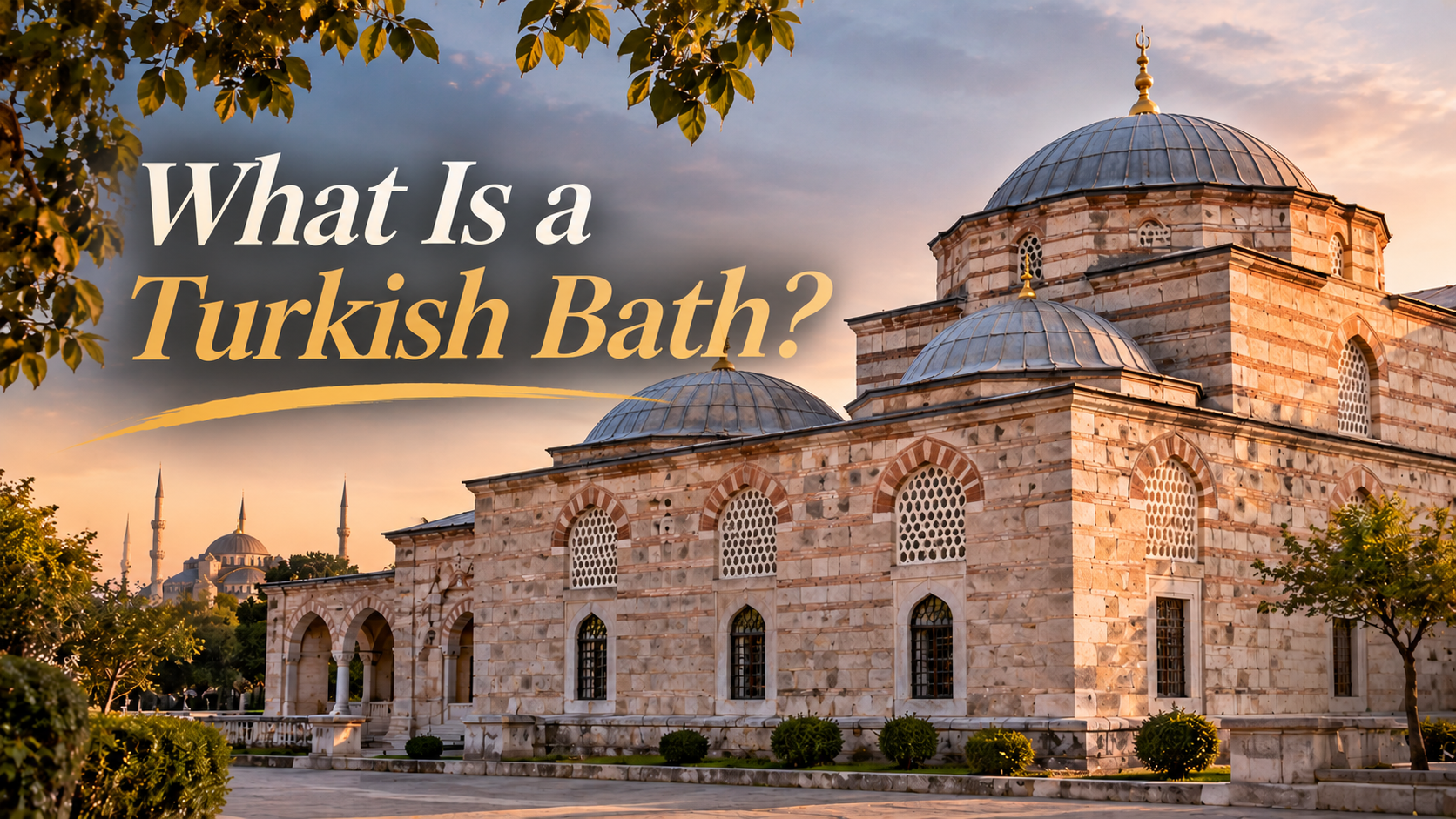
What Is a Turkish Bath? History, Architecture and Traditional Hammam Culture
A Turkish bath, also known as a Turkish hammam or Ottoman bathhouse, is a traditional bathing establishment that combines heated rooms, running water, marble bathing surfaces and ritualised washing practices. Developed over centuries, the Turkish bath became an essential feature of urban life throughout Anatolia and the wider Ottoman world.
Unlike an ordinary modern bathroom, a traditional Turkish hammam is designed around a sequence of spaces with different temperatures. Visitors usually begin in a changing and resting area before moving through warmer rooms into the main bathing chamber.
- What Is a Turkish Bath? History, Architecture and Traditional Hammam Culture
- What Does Hammam Mean?
- When Were Turkish Baths Invented?
- Why Were Turkish Baths So Important in Ottoman Society?
- What Are the Main Rooms of a Traditional Turkish Bath?
- What Is the Göbek Taşı in a Turkish Bath?
- What Is a Kurna?
- Why Do Turkish Baths Have Domes?
- How Does the Heating System of a Turkish Bath Work?
- What Happens in a Traditional Turkish Bath?
- What Should You Wear in a Turkish Bath?
- What Is a Double Hammam?
- Traditional Turkish Bath Accessories
- Famous Historic Turkish Baths in Istanbul
- Turkish Bath vs Roman Bath: What Is the Difference?
- Turkish Bath vs Sauna: Are They the Same?
- Are Turkish Baths Always Full of Steam?
- What Were Bridal Hammams?
- The Artistic Importance of Ottoman Hammams
- Why Are Turkish Baths Important Cultural Heritage?
- Frequently Asked Questions About Turkish Baths
- What is a Turkish bath in simple terms?
- What is the difference between a Turkish bath and a hammam?
- What happens during a Turkish bath?
- What do you wear in a Turkish bath?
- Is a Turkish bath the same as a sauna?
- Is a Turkish bath a steam room?
- What is the heated marble slab called?
- What is a kurna?
- What is the hottest room in a Turkish bath?
- Why do Turkish baths have domes?
- What is a kese in a Turkish bath?
- Are Turkish baths separated for men and women?
- Who invented the Turkish bath?
- How old are Ottoman Turkish baths?
- Did Mimar Sinan design Turkish baths?
- Where can you see historic Turkish baths in Istanbul?
- What is a bridal hammam?
- Why are Turkish baths historically important?
- Conclusion: More Than a Traditional Bathing Experience
- References and Further Reading
- Image Credits
Historic hammams are recognised for their impressive domes, marble basins, heated stone platforms and carefully engineered water and heating systems.

However, Turkish baths are much more than beautiful historic buildings. For centuries, they served as places of personal hygiene, social interaction, community gatherings and traditional celebrations.
Many of Istanbul’s surviving Ottoman hammams remain significant examples of the city’s architectural and cultural heritage. The Haseki Hürrem Sultan Hammam, Çemberlitaş Hammam and Cağaloğlu Hammam are particularly well-known examples.
So what exactly is a Turkish bath, how does it work, and what makes it different from a sauna or Roman bath? This guide examines the history, architecture, bathing traditions and cultural significance of Turkish hammams, with a special focus on their development during the Seljuk and Ottoman periods.

What Does Hammam Mean?
The word hammam comes from Arabic and is associated with heat and bathing. In Turkish, the word is written as hamam.
In English, the expressions Turkish bath, Turkish hammam and Ottoman hammam are commonly used when discussing Turkey’s historic communal bathing traditions.
Although these terms are closely related, not every hammam was built by the Ottomans or located in Turkey.
Bathhouses are found throughout the Middle East, North Africa, the Balkans and other regions influenced by different Islamic and Mediterranean architectural traditions.
The Ottoman Turkish hammam represents one particularly important development within this much broader history of public bathing.
When Were Turkish Baths Invented?
There is no single date when the Turkish bath was invented.
Its architectural history developed through the interaction of ancient bathing traditions, Roman and Byzantine engineering, Islamic bathing practices and the building cultures of Anatolia.
Although Ottoman baths share certain technical features with Roman bathhouses, they developed distinctive spatial arrangements and cultural practices.
Ancient Greek Bathing Traditions
Bathing facilities existed in the ancient Greek world long before the Ottoman Empire.
In Greek society, bathing was associated with personal cleanliness, physical exercise and various social activities.
Public bathing facilities and washing areas developed alongside gymnasia and other institutions.
Some Hellenistic establishments incorporated heated rooms, contributing to the wider development of Mediterranean bathing architecture.
Roman Baths and Their Influence
Public baths became major architectural institutions under the Roman Empire.
Large Roman bath complexes could include rooms of different temperatures, pools, exercise areas and spaces for social interaction.
The Roman bathing sequence often involved the frigidarium, tepidarium and caldarium, corresponding broadly to cold, warm and hot bathing environments.
Roman engineers also developed heating arrangements that circulated hot gases beneath floors and, in some buildings, through wall cavities.
This form of underfloor heating, commonly known as the hypocaust, represents an important technological predecessor to heating systems used in later bathhouses.
Bathing in the Byzantine World
Public and private bathing facilities continued to exist during the Byzantine period.
However, the architectural scale, social organisation and distribution of bathhouses changed over time.
Some later Byzantine bathhouses were considerably smaller than the monumental imperial complexes of ancient Rome.
These developments formed part of the architectural environment inherited and transformed by later societies in Anatolia.
Baths under the Seljuks
Bathhouses played an important role in the urban and architectural development of Seljuk Anatolia.
As cities expanded, baths were constructed alongside mosques, caravanserais, markets and other public buildings.
Seljuk bathhouses incorporated different bathing spaces, service rooms and heating arrangements.
Their plans were not identical, but several architectural principles remained influential in later Anatolian and Ottoman bath design.
The Ottoman Development of the Turkish Hammam
During the Ottoman period, hammams became prominent institutions in towns and cities.
Bathhouses were constructed for neighbourhoods, markets, charitable complexes and important urban centres.
Some were commissioned by members of the ruling family, prominent officials or other wealthy patrons.
By the sixteenth century, Ottoman architects had developed sophisticated arrangements of domed changing rooms, heated bathing chambers, private washing cells and integrated heating systems.
The hammam became one of the most recognisable building types associated with Ottoman urban civilisation.
Why Were Turkish Baths So Important in Ottoman Society?
For many urban residents, public hammams provided access to heated washing facilities at a time when modern domestic bathrooms and centralised hot-water systems did not exist.
The baths also offered shared spaces for resting, meeting acquaintances and participating in community traditions.
They were connected to the economic and institutional life of Ottoman cities.
Public Hygiene
Regular washing was an important part of daily life and personal cleanliness.
Communal baths offered practical facilities for washing, especially where household bathing arrangements were limited.
Religious and Cultural Context
Cleanliness has an important place in Islamic religious practice.
However, it would be misleading to suggest that every visit to an Ottoman hammam was exclusively religious.
Bathing also fulfilled ordinary personal, social and recreational needs.
Social Gatherings
Historic hammams were places where people could gather, converse and participate in customary celebrations.
Practices differed according to region, period, social group and the type of bathhouse.
Charitable Endowments
Many Ottoman hammams were connected to charitable endowments known as waqf or, in Turkish, vakıf.
Income from baths could contribute to the upkeep of mosques, schools, charitable kitchens and other institutions.
This made hammams economically important buildings as well as centres of hygiene and public life.
What Are the Main Rooms of a Traditional Turkish Bath?
One of the defining architectural features of a Turkish hammam is its organisation into spaces with different functions and temperatures.
The exact layout varies according to the date, size and regional tradition of the building.
1. The Changing Room — Soyunmalık
The soyunmalık is the changing and resting area of a Turkish bath.
In large historic hammams, this is often one of the most spacious rooms.
It may contain raised seating platforms, changing compartments and a central fountain or pool.
Many Ottoman changing rooms are covered by impressive domes.
Visitors traditionally prepared for bathing in this room and returned to it afterwards to rest and dress.
2. The Transitional Area — Aralık
Some historic baths include a transitional space called the aralık.
This room connects different parts of the bath and may help separate rooms with contrasting temperatures.
Its arrangement varies, and not all hammams contain a distinct aralık.
3. The Warm Room — Ilıklık
The ılıklık is an intermediate warm room situated between the changing area and hotter bathing spaces.
It forms part of the gradual temperature transition experienced by visitors.
In some historic descriptions, related spaces are described using the term soğukluk.
Because traditional terminology developed differently across periods and regions, the names should not be treated as universally interchangeable.
4. The Hot Room — Sıcaklık
The sıcaklık is the main heated bathing chamber.
It commonly includes marble washing basins, heated floor surfaces and areas for washing.
In many monumental Ottoman baths, the hot room is covered by a central dome surrounded by smaller architectural spaces.
The sıcaklık is particularly associated with the traditional experience of a Turkish bath.
5. Private Bathing Cells — Halvet
A halvet is a smaller washing compartment that may be attached to the main hot room.
These cells often occupy corners or other designated sections of the bathing complex.
The term does not necessarily mean a completely private modern bathroom.
Its specific form and use depend on the architectural arrangement of the bathhouse.
6. The Furnace — Külhan
The külhan is the furnace or heating service area of a traditional hammam.
Fuel was burned in this area to provide heat for the bathing rooms and water system.
The furnace was normally separated from the spaces used by bathers.
7. The Underfloor Heating Area — Cehennemlik
The term cehennemlik is associated with the underfloor heating spaces of traditional Turkish baths.
In certain systems, heated air and combustion gases travelled beneath the floors, warming the surfaces above.
These arrangements have important historical connections with earlier Mediterranean heating technologies.
8. Water Reservoirs
Water supply and storage were essential to the functioning of a hammam.
Historic bathhouses required an organised system for supplying hot and cold water to their various rooms.
Reservoirs, pipes, channels and heating installations formed part of this technical infrastructure.
What Is the Göbek Taşı in a Turkish Bath?
The göbek taşı is a raised stone or marble platform located in the central bathing area of many Turkish hammams.
It is often translated into English as the central heated marble platform or belly stone.
The surface is heated through the building’s thermal system in traditional arrangements.
Bathing attendants may use this platform for washing, exfoliation and foam-based services.
Visitors may also rest on it during their bathing experience.
Although the göbek taşı is widely recognised as a symbol of the Turkish bath, its exact dimensions and form vary between historic buildings.
What Is a Kurna?
A kurna is a stone or marble basin used for washing in a traditional hammam.
Water is collected from the basin using a bowl, often called a hamam tası.
Traditional kurnas are frequently located along the walls of the bathing chambers.
Some historic examples feature carefully carved stonework and decorative details.
Why Do Turkish Baths Have Domes?
Domes are among the most recognisable architectural elements of Ottoman hammams.
They provide a structural solution for covering major interior spaces and create a distinctive architectural atmosphere.
Historic hammams often combine domes with smaller vaults and transitional architectural elements.
However, not every part of an Ottoman bathhouse is necessarily covered by a dome.
Small Glass Skylights
Many traditional hammams include small circular or polygonal skylights set into the domes.
In Turkish architectural terminology, these openings are often referred to as fil gözü.
They introduce daylight into bathing chambers without requiring large external windows.
In some historic buildings, the skylights are covered with glass elements.
It would therefore be incorrect to assume that every skylight also functions as an open ventilation hole.

How Does the Heating System of a Turkish Bath Work?
Traditional Turkish baths use a heating system that combines hot-water production with the heating of selected interior surfaces.
The furnace is usually situated in a service area near the water-storage and heating installations.
Heat generated by burning fuel can be transferred to water and circulated beneath floors through appropriate channels and cavities.
The precise details vary between buildings and historical periods.
Connection to the Roman Hypocaust
Roman bathhouses used underfloor heating systems in which hot gases travelled beneath raised floors.
Ottoman hammam heating systems share some general technological principles with these earlier arrangements.
Nevertheless, Ottoman bathhouses should not be described simply as unchanged Roman baths.
Their architectural plans, use of water, social organisation and construction traditions evolved substantially.
Heating the Marble Surfaces
In some traditional hammams, heated air circulating beneath the floor helps warm the stone surfaces.
This is one reason why the göbek taşı and other bathing areas can retain warmth.
Heating arrangements need to be studied individually rather than assuming identical systems across all hammams.
What Happens in a Traditional Turkish Bath?
For international visitors, one of the most common questions is what to expect during a Turkish hammam experience.
Modern hammam services can differ considerably from historical bathing customs.
The following sequence describes a typical contemporary traditional-style experience rather than a fixed ritual followed identically in every period.
Step 1: Entering the Changing Area
Visitors enter the changing room, where they change clothes and prepare for the bathing session.
Traditional cotton wraps called peştamal may be provided.
Step 2: Moving into the Warm Rooms
The visitor moves into a warmer part of the bath.
The temperature transition is designed to make the bathing process gradual.
Step 3: Relaxing in the Hot Room
In the main hot room, visitors usually spend some time warming up.
They may sit or lie on heated stone surfaces.
Step 4: Washing with Water
Traditional washing commonly involves drawing water from a marble basin and pouring it over the body.
This practice differs from simply sitting in a hot pool.
Step 5: Exfoliation with a Kese
A kese is a textured exfoliating mitt traditionally associated with Turkish bathing.
In many modern hammams, an attendant performs a scrubbing treatment using a kese.
Exfoliation services vary and may be optional.
Step 6: Foam Washing
Many present-day Turkish baths offer washing with soap foam.
This service is particularly popular among tourists.
However, modern commercial foam treatments should not automatically be treated as identical to every historical Ottoman bathing practice.
Step 7: Resting and Cooling Down
After washing, visitors return to a cooler or resting space.
They may dry themselves, change clothes and relax before leaving.
What Should You Wear in a Turkish Bath?
Traditional bathing attire varies according to the hammam, its rules and local customs.
A peştamal, a lightweight cotton wrap, is one of the best-known garments associated with Turkish baths.
Some modern establishments provide disposable underwear, towels or other bathing items.
Others may have separate rules for swimwear.
Visitors should always check the requirements of the specific hammam they intend to visit.
Are Turkish Baths Separated by Gender?
Historically, some Ottoman establishments were designed as double hammams, with separate facilities for men and women.
Other bathhouses used a single bathing area at different times for different groups.
Present-day arrangements vary according to the establishment.
What Is a Double Hammam?
A double hammam, or çifte hamam, is a bathhouse containing two separate sets of bathing spaces, traditionally associated with men’s and women’s use.
These sections may have independent entrances.
In some buildings they share aspects of the heating and water-supply infrastructure.
The architectural arrangement of a double hammam is an important feature of Ottoman bathhouse planning.
Traditional Turkish Bath Accessories
Turkish bathing culture includes various objects that are historically significant as examples of decorative art and everyday material culture.
Peştamal — Cotton Bath Wrap
A peştamal is a woven textile used to cover the body during bathing.
Different regional weaving traditions produced a range of patterns, materials and decorative styles.
Hamam Tası — Bathing Bowl
A hamam tası is a bowl used to scoop water from a basin.
Historic examples were made from copper and other materials.
Some bowls feature engraved or embossed decorative motifs.
Nalın — Wooden Bath Clogs
Nalın are elevated wooden clogs traditionally associated with wet bathing environments.
Some surviving historic examples are finely decorated with metal, mother-of-pearl and other materials.
They represent an interesting intersection between daily function and the decorative arts.
Kese — Exfoliating Mitt
The kese is a traditional textured washing accessory used for scrubbing the skin.
Different materials and methods have been used across periods and regions.
Bath Bundles and Textiles
Personal bathing accessories were sometimes carried in special textile bundles.
These objects are important for understanding the social customs of Ottoman everyday life.
Famous Historic Turkish Baths in Istanbul
Istanbul contains a remarkable collection of Ottoman bathhouses reflecting different architectural periods.
Some continue to function as baths, while others have been restored or adapted for cultural purposes.
Haseki Hürrem Sultan Hammam
The Haseki Hürrem Sultan Hammam is situated in the historic Sultanahmet district of Istanbul, near Hagia Sophia.
The bath was commissioned by Hürrem Sultan, wife of Sultan Süleyman the Magnificent, and designed by the imperial architect Mimar Sinan.
According to Istanbul Metropolitan Municipality’s cultural heritage inventory, the building was constructed in 1556–1557.
The hammam is notable for its architectural arrangement, which includes separate bathing sections for men and women.
It underwent restoration and returned to use as a bathhouse in 2011.
The monument represents one of the important surviving examples of sixteenth-century Ottoman bath architecture.
Çemberlitaş Hammam
Çemberlitaş Hammam is a historic bathhouse in Istanbul’s old city.
Commonly dated to 1584, the building is associated with Nurbanu Sultan’s charitable endowments and traditionally attributed to Mimar Sinan.
It is especially significant for its monumental bathing spaces and its long history as part of Istanbul’s urban life.
As with other continuously used historic buildings, repairs and alterations must be taken into account when studying its architecture.
Cağaloğlu Hammam
Cağaloğlu Hammam is another notable Ottoman bathhouse in Istanbul.
Built during the reign of Sultan Mahmud I in the eighteenth century, it is associated with the revenue arrangements supporting a library at Hagia Sophia.
Its architecture reflects a later stage in the development of Istanbul’s monumental public hammams.
II Bayezid Hammam
The historic Bayezid II Hammam is an important example of Ottoman bath architecture and bathing heritage.
The building now houses the Turkish Bath Culture Museum associated with Istanbul University.
Its displays help visitors understand traditional bathing accessories, historical practices and the cultural importance of hammams.
Turkish Bath vs Roman Bath: What Is the Difference?
Although Ottoman hammams inherited several architectural and technological traditions from earlier Mediterranean bathhouses, their spatial organisation is distinctive.
Large Roman bath complexes often included various pools and supplementary facilities for exercise and recreation.
Traditional Ottoman hammams are particularly associated with washing at individual stone basins, heated floors and central marble platforms.
Both traditions used specialised heating systems and rooms of different temperatures.
The difference is therefore not simply one of heat or the presence of a dome, but of architecture, cultural practice and historical development.
Turkish Bath vs Sauna: Are They the Same?
No. A traditional Turkish bath is not the same as a sauna.
A Turkish hammam centres on washing with water in purpose-built spaces with heated stone surfaces.
A sauna is generally organised around sitting in a highly heated room, often with a different temperature and humidity profile.
Contemporary spas may combine the two experiences, but they originate from different bathing traditions.
A Turkish bath is also not necessarily the same as a modern steam room.
Are Turkish Baths Always Full of Steam?
Not necessarily.
Traditional Ottoman hammams are heated and humid environments, but their operation differs from that of modern sealed steam rooms.
Humidity depends on ventilation, water use, building design and heating conditions.
It would therefore be inaccurate to describe every historic Turkish bath as a room continuously filled with dense steam.
What Were Bridal Hammams?
A bridal hammam, known in Turkish as gelin hamamı, is a traditional bathing gathering associated with weddings.
In various regions, members of the bride’s family and social circle could participate in a special hammam occasion.
Such gatherings might involve bathing, conversation and celebratory activities.
The traditions varied considerably according to local customs, social conditions and historical period.
Other Social Bathing Traditions
Bathing customs associated with marriage, childbirth and other life events existed in certain communities.
However, the historical record does not support treating every local hammam tradition as a universal practice across the entire Ottoman world.
The Artistic Importance of Ottoman Hammams
Ottoman bathhouses are important monuments of architectural history, but they are also associated with the decorative arts.
Stone carving, marble workmanship, domed construction and carefully arranged architectural proportions contribute to their aesthetic character.
Marble Workmanship
Marble was often used for water basins, platforms, floors and other important bathing elements.
The treatment of these surfaces reflects both practical requirements and architectural design.
Domes and Vaults
Different forms of vaulting and domed construction shaped the interior volumes of historic hammams.
Architects used these elements to cover rooms, organise spaces and introduce natural light.
Stone and Brick Construction
Many historic Turkish baths combine stone and brick building materials.
The choice of materials, structural systems and finishes depends on the period and regional architectural tradition.
Spatial Geometry
Some Ottoman bathhouses feature central bathing chambers organised with surrounding recesses and smaller compartments.
The geometry of these spaces contributes to the distinctive experience of moving through the building.
Why Are Turkish Baths Important Cultural Heritage?
Historic hammams preserve evidence of architectural engineering, urban organisation and social customs.
They demonstrate how societies provided shared bathing facilities before modern plumbing became widespread.
They also reveal the role of charitable foundations and urban institutions in supporting public services.
The architectural value of a hammam is not limited to its visible domes and marble surfaces.
Its historical heating installations, water distribution, wall finishes and original spatial organisation are equally significant.
Conservation Challenges
Historic bathing buildings may be affected by moisture, temperature fluctuations, material deterioration and inappropriate alterations.
Conservation therefore requires specialists to understand both the building fabric and its technical systems.
Adaptive Reuse
Some former hammams have been converted into museums, cultural institutions or other public spaces.
Appropriate reuse can help preserve historic buildings, provided the new function respects their architectural and archaeological significance.
Frequently Asked Questions About Turkish Baths
What is a Turkish bath in simple terms?
A Turkish bath is a traditional bathing facility with heated rooms, water basins and spaces for washing and resting. It is also known as a hammam.
What is the difference between a Turkish bath and a hammam?
The words are often used interchangeably in English. Hammam is a broader term used for traditional bathhouses across several regions, while Turkish bath commonly refers to the Turkish and Ottoman tradition.
What happens during a Turkish bath?
A typical contemporary experience may involve changing into a bath wrap, warming up, washing with water, exfoliation, optional foam washing and resting afterwards.
What do you wear in a Turkish bath?
Visitors often wear a peştamal or other attire specified by the establishment. Rules vary, so check before visiting.
Is a Turkish bath the same as a sauna?
No. Turkish baths are centred on washing with water and heated stone surfaces, while saunas follow a different tradition of heat exposure.
Is a Turkish bath a steam room?
Not exactly. Historic hammams use heated rooms and water, but their architecture and operation differ from those of modern steam rooms.
What is the heated marble slab called?
It is called a göbek taşı, meaning the central heated stone platform of many traditional Turkish baths.
What is a kurna?
A kurna is a stone or marble basin from which bathers draw water for washing.
What is the hottest room in a Turkish bath?
The sıcaklık is generally the principal heated bathing chamber.
Why do Turkish baths have domes?
Domes cover large interior spaces and often contain small skylights that provide natural daylight.
What is a kese in a Turkish bath?
A kese is a traditional textured exfoliating mitt used during washing and scrubbing treatments.
Are Turkish baths separated for men and women?
Some traditional buildings have separate sections, while others historically used different bathing times. Modern arrangements depend on the establishment.
Who invented the Turkish bath?
The Turkish bath evolved over centuries from several Mediterranean, Islamic, Anatolian and Ottoman bathing traditions. It cannot be attributed to one inventor.
How old are Ottoman Turkish baths?
Ottoman hammams were built throughout the history of the empire. Many surviving monumental examples date from the fifteenth to eighteenth centuries.
Did Mimar Sinan design Turkish baths?
Yes. Mimar Sinan designed important Ottoman bathhouses, including the Haseki Hürrem Sultan Hammam in Istanbul.
Where can you see historic Turkish baths in Istanbul?
Well-known examples include the Haseki Hürrem Sultan Hammam, Çemberlitaş Hammam, Cağaloğlu Hammam and Bayezid II Hammam.
What is a bridal hammam?
A bridal hammam is a traditional gathering associated with weddings in some Turkish communities.
Why are Turkish baths historically important?
They preserve significant evidence of Ottoman architecture, heating technologies, urban institutions and social customs.
Conclusion: More Than a Traditional Bathing Experience
The Turkish bath is one of the distinctive expressions of Ottoman architectural and social heritage.
Its characteristic sequence of changing rooms, warm spaces and heated bathing chambers reflects centuries of architectural development and practical experience.
Yet the importance of hammams extends well beyond their physical design.
They played important roles in public hygiene, neighbourhood life, social gatherings and the charitable institutions of Ottoman cities.
Historic buildings such as the Haseki Hürrem Sultan Hammam and Çemberlitaş Hammam illustrate the artistic and technological achievements of Ottoman bathing architecture.
In short, a Turkish bath is not simply a place to wash. It is a historic institution where architecture, engineering, community life and cultural traditions meet.
References and Further Reading
-
Eyice, Semavi (1997).
“Hamam.” TDV Encyclopaedia of Islam.
Read the architectural study. -
Istanbul Metropolitan Municipality.
“Haseki Hürrem Sultan Hamamı.” Cultural Heritage Inventory.
Official heritage record. -
Eyice, Semavi (1993).
“Cağaloğlu Hamamı.” TDV Encyclopaedia of Islam.
Read the historical research. -
Haseki Hürrem Sultan Hammam.
“About Us: Historical Architectural Texture.”
Explore the building’s history. -
İstanbul University.
Turkish Bath Culture Museum, historical and ethnographic collections.
Official museum information.
Image Credits
- Haseki Hürrem Sultan Hammam — Yair Haklai, Wikimedia Commons, CC BY-SA 4.0.
- Çemberlitaş Hammam Interior — Fran Villena, Wikimedia Commons, CC BY 2.0.
Read this article in Turkish:
Türk Hamamı Nedir? Tarihi ve Mimari Özellikleri.



Bir Cevap Yaz
E-posta adresiniz yayınlanmayacak. Gerekli alanlar * ile işaretlenmişlerdir.